A case for Monero: why we accept private cryptocurrency
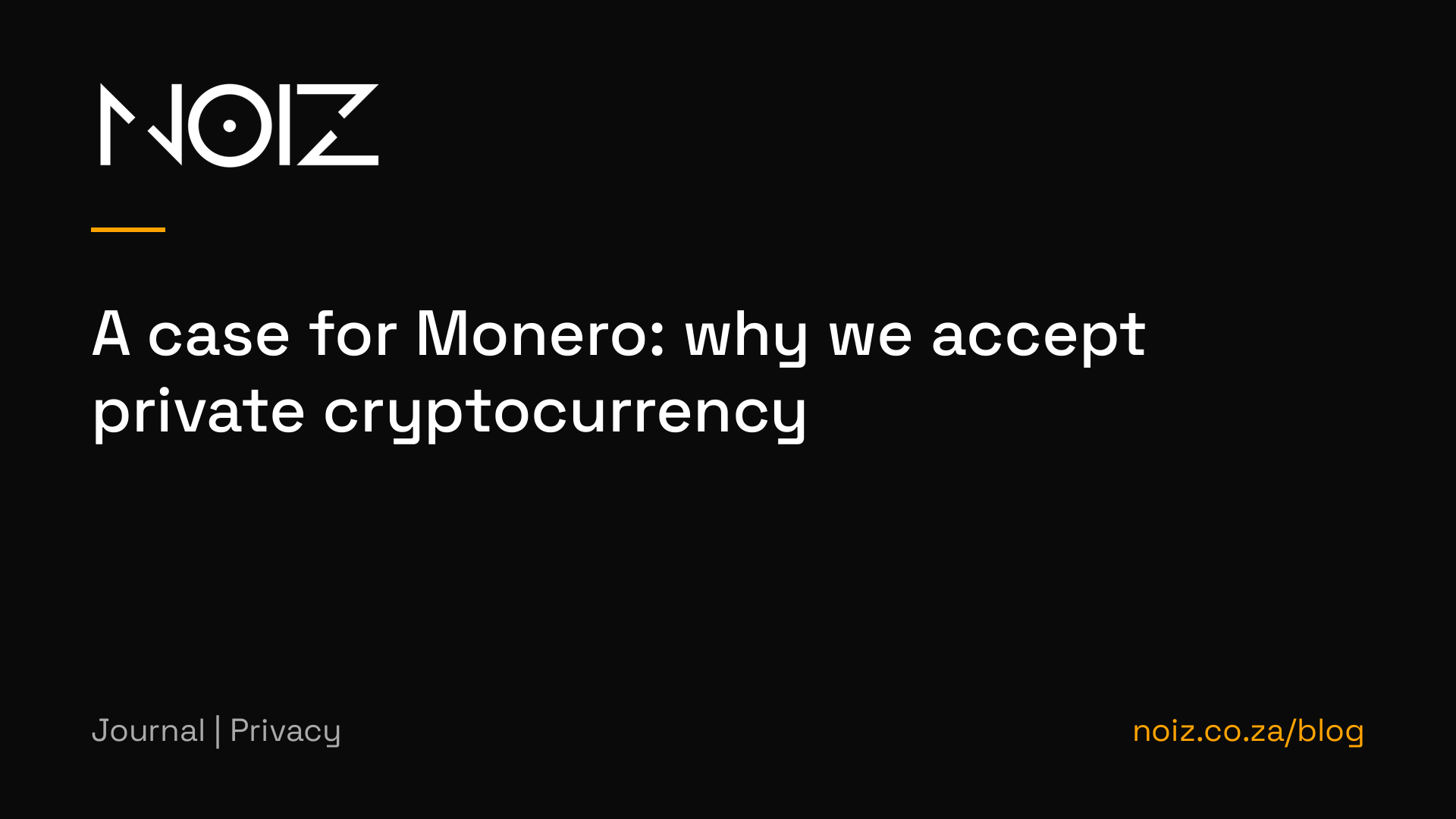
Cash is private by default: when you pay a shopkeeper, nobody else learns what you bought, from whom or how much you had left. Most digital payments leave a lasting record with several parties, and most cryptocurrencies go further, publishing every transaction on a ledger anyone can read. Monero is built differently. Its design hides the sender, the receiver and the amount of every payment, which makes it the closest digital equivalent to cash. Noiz accepts it on every invoice because financial privacy belongs with the other kinds of privacy we protect.
The problem with a public ledger
Bitcoin and most cryptocurrencies record every transaction on a public blockchain. Addresses are not names, but once an address is linked to a person or a business, through an exchange, an invoice or a single careless payment, its whole history can be read: every payment in, every payment out, and the balance.
For an ordinary business that is a real exposure. A competitor could see who you pay and how much. A supplier could see your balance before negotiating. Anyone who learns your address can watch your takings. None of that requires wrongdoing by anyone; it is how a transparent ledger works.
A public ledger also affects the coins themselves. Monero's own documentation points out that on Bitcoin any coin can be traced back through its history, so a business may feel obliged to refuse coins that were once misused, through no fault of the person paying. Money whose value depends on its history is not fully interchangeable.
How Monero keeps payments private
Monero combines three techniques, each hiding a different part of a transaction.
| Technique | What it hides | How |
|---|---|---|
| Stealth addresses | The receiver | Every payment goes to a new one-time address, so a merchant can publish one address while each payment lands somewhere unlinkable |
| Ring signatures | The sender | Each payment is signed in a way that any member of a group, mixed with decoys from the blockchain, could have made |
| RingCT | The amount | Ring Confidential Transactions hide how much was sent; mandatory for all transactions since 2017 |
Fungibility: every coin is equal
Because no coin carries a visible history, every unit of Monero is interchangeable with every other. Monero describes itself as built specifically to address traceability and non-fungibility. For a business that accepts it, that means a payment is a payment, with no need to investigate where each coin has been.
Private, and optionally transparent
Privacy does not stop a business from keeping proper books. Every Monero address has a private view key, which can be shared with an accountant or an auditor to show incoming payments without giving them the power to spend. Monero calls this private, optionally transparent.
Built to last
Two design choices keep the network healthy over time:
- Tail emission. Since May 2022, every new block pays a small, fixed reward to the miners who secure the network, so they always have a reason to keep doing so, even as transaction fees fall.
- RandomX. Monero's mining algorithm is designed for ordinary computer processors and to discourage specialised mining hardware, with the intent of keeping mining spread across many people.
What Monero cannot promise
The Monero project is candid about its limits, and so are we. Its own FAQ says there is no such thing as 100% anonymous, that software can have bugs, and that users should use common sense and defence in depth. In practice:
- Where you bought it still knows you. An exchange that sold you Monero holds your identity and the withdrawal, as South African rules require.
- The person you pay knows it was you. Monero keeps a payment private from the world, not from the recipient.
- Privacy depends on security. A wallet on an infected computer, or a recovery phrase stored in a photo on your phone, undoes the best cryptography.
Why Noiz accepts Monero
Noiz describes itself as an organised cypherpunk movement focused on digital privacy, software freedom, open source, decentralisation and censorship resistance. Accepting private money is that position applied to payment. Our values say it in two words: privacy first, with data belonging to the client.
In practice, a client paying in Monero chooses it on the invoice, which shows the exact amount and the address, and sends the payment from a wallet they control.
Paying, and accepting, Monero
To pay a Noiz invoice in Monero, our knowledgebase article Pay with Monero (XMR) keeps the current procedure. If you would like to accept Monero in your own business, the Monero project's guide to accepting Monero is the place to start.
Sources
Checked 19 October 2026.
Monero
- What is Monero?
- Monero FAQ
- Accepting Monero
- Moneropedia: ring signatures, stealth addresses, RingCT, fungibility, tail emission, RandomX and view key
Noiz
- About Noiz
- Pay with Monero (XMR)
- The original essays on Noiz Ireland: A case for private cryptocurrency and Privacy coins: exploring Monero
Note: while some of this content was produced with the help of AI, the final editing has been done by a real human being.