GD is PHP's built-in image processing library. If a site needs to resize an upload, generate a thumbnail, stamp a watermark, draw a CAPTCHA or render a chart, it is almost always GD doing the work. When GD is missing you tend to see it as a symptom rather than an error: uploaded images stay full size, thumbnails come out blank, a CAPTCHA renders as a broken image, or an installer refuses to continue with a message such as The GD extension is required.
On Noiz cPanel hosting that runs CloudLinux, you enable GD yourself from your own cPanel account. No support ticket and no server restart is needed. This guide covers the CloudLinux PHP Selector, which appears in cPanel under the Select PHP Version icon, and the things that most often make the change appear not to work.
Last reviewed: 27 July 2026, against cPanel & WHM version 134 (the current stable and LTS tier in cPanel's own release tiers) with the CloudLinux PHP Selector on the current CloudLinux OS release. This guide is written for Noiz hosting and is kept current against cPanel and CloudLinux. It complements, and does not replace, the official documentation linked below.
Official Documentation Reference
- CloudLinux OS documentation: PHP Selector (how the Selector, alt-php and CageFS fit together)
- PHP Manual: Image Processing and GD
- PHP Manual: GD installation and requirements
- cPanel documentation: MultiPHP Manager (per-domain PHP versions, which can override what you set here)
Prerequisites
- An active Noiz cPanel hosting account and your cPanel login.
- A cPanel account on a server running CloudLinux. If the Select PHP Version screen shows a version drop-down with Extensions and Options tabs, you have the CloudLinux PHP Selector.
- Your account set to a specific PHP version rather than
native. See How to Change the PHP Version via CloudLinux Selector in cPanel if you need to change it first.
Enable the GD Extension
1. Log in to cPanel
Log in to your cPanel account at the address supplied in your Noiz welcome email.
2. Open Select PHP Version
In the Software section, click Select PHP Version.

3. Open the Extensions tab
Click the Extensions tab. This lists every extension available for the PHP version your account is currently using, with a tick box next to each one.
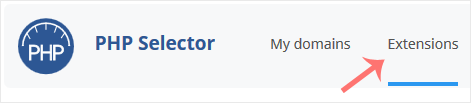
Note: if the Extensions tab shows an error, or the list is empty, your account is almost certainly still set to the native PHP version. The native build is the server's own PHP and its extension set is fixed, so the Selector cannot manage it. Switch the version drop-down to a specific version such as 8.3, then return to Extensions.
4. Tick GD
Scroll to gd in the list and tick it. There is no Save button: the Selector saves the change as soon as you tick the box and confirms it on screen.
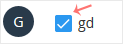
The confirmation message reads that the module gd is saved. That message is the only confirmation you get, so if it does not appear, the change did not take.
Confirm GD Is Actually Loaded
The Selector confirms that it saved your choice, which is not quite the same as PHP having loaded the extension. Running PHP processes finish their current work before recycling, so allow up to a minute and then check one of the following.
- A phpinfo page. Create a file containing
<?php phpinfo();, load it in your browser, and search the page for a gd section. Delete the file afterwards: it exposes a great deal about your configuration. - Terminal or SSH. Run the command below. The account's selected PHP version is what you get by default.
php -m | grep -i gd- WordPress. Go to Tools > Site Health > Info > Media Handling, which reports whether GD is present and which image formats it supports.
What to Know Before You Change This
- The setting is per account, not per domain. The PHP Selector applies to the whole cPanel account. Every domain and subdomain that follows the account's PHP version picks up the extension.
- A per-domain PHP version can override it. If a domain has been pinned to a different PHP version in MultiPHP Manager, that domain runs a different PHP build with its own extension list, and your change will not reach it. This is the single most common reason GD appears enabled but the site still complains.
- GD is not Imagick. They are separate extensions with separate tick boxes. Some applications prefer Imagick and fall back to GD, others use only one. Enabling GD does not enable Imagick.
- Extensions are not free. Each enabled extension adds memory to every PHP process. Enabling a long list of extensions you do not use makes it easier to hit your account's memory limit under load. Enable what the application asks for and leave the rest alone.
- Some builds include GD already. If the tick box is already ticked and cannot be cleared, GD is compiled into that PHP build and there is nothing to do.
- Switching PHP version resets the picture. Extensions are stored per PHP version. If you later move the account from PHP 8.2 to 8.3, check the Extensions tab again, because the new version has its own set of enabled modules.
Troubleshooting
Symptom: the Extensions tab shows an error about the native PHP version. Change the version drop-down from native to a specific PHP version, then reopen the Extensions tab.
Symptom: gd is ticked but the application still reports it as missing. Check MultiPHP Manager for a per-domain PHP version that differs from the account version, and confirm with a phpinfo page loaded on that exact domain rather than on another one.
Symptom: images upload but are never resized, and no error appears. Many applications degrade quietly without GD. Confirm GD is loaded first, then clear any image or page cache and re-upload a test image, because the original upload will not be reprocessed on its own.
Symptom: gd is not in the Extensions list at all. The list is specific to the selected PHP version. Very old or very new PHP versions carry different module sets. Try a currently supported version, and if GD is still absent, open a support ticket with Noiz and quote the PHP version you selected.
Symptom: the tick box reverts when you reload the page. The change was not saved. Watch for the on-screen confirmation as you tick the box, and try again with browser extensions such as ad blockers disabled, since the Selector saves in the background and a blocked request fails silently.
Related Articles
- How to Enable or Disable PHP Extensions Using the CloudLinux Selector in cPanel
- How to Change the PHP Version via CloudLinux Selector in cPanel
- How to Enable the GD Extension of PHP Using CloudLinux Selector in DirectAdmin
If the Extensions tab does not appear on your account, or GD is loaded and the site still will not process images, open a support ticket from your Noiz client area with the domain name and the PHP version you selected, and the Noiz support team will check the account configuration for you.